The first rule of fencing is “don’t get hit” and the safest way to do that is by always be controlling and dominating our opponent’s sword. That’s why in this month in rapier class, we’re focusing on blade control.
It Starts With a Good Finding
We want to find our opponent’s blade so they can’t easily attack us with a straight thrust as we try to maneuver into measure (few things feel worse than getting “one-shotted” in the list).
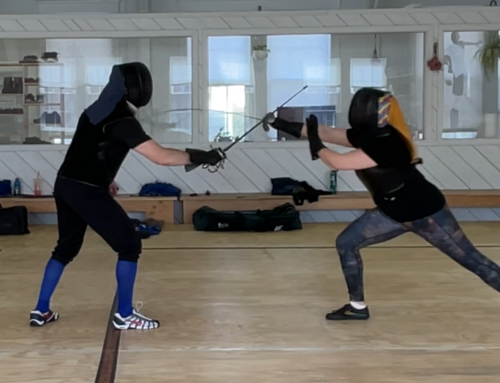
Blade finding and engagements keeps us safe from direct attacks and buys us extra time to react should our opponent try to strike us with an indirect attack, like a disengagement. It consists of three advantages:
- Crossing (over their weapon)
- Leverage (our strong on their weak)
- True Edge (knuckle-side of the blade facing theirs)
Once we’ve found our opponent’s blade, we may or may not be at the right distance for attacking. And attacking an opponent that is in wait is dangerous; it’s why it’s so difficult to strike by glide successfully. We want to get to a position where our opponent is at a strong mechanical and tactical disadvantage. We have two main options for doing this:
- If we’re in measure and want to initiate a tempo (aka opportunity) to attack, we can feint and disengage/deceive around their parry (or counter their counter-attack)
- OR we can creep in a little closer to increase our domination over their weapon, putting tactical pressure on our opponent.
Similarly, our opponent may realize they’re at a disadvantage by having their blade dominated by ours and see to free it. If they do this while remaining fixed in measure, it’s a good tempo (or opportunity) to strike.
Pursuit Predators
If our opponent is a bit more cautious, they’ll retreat while trying to free their blade. In this case, we’ll want to counter their blade action and pursue them. There are times when we can still attack successfully while they retreat but it’s usually more difficult.
If we can steal some distance from them in the process, all the better, but the main goal is to keep control of their weapon while we pursue them. As they retreat and free their blade, we want to pursue and counter their blade action so we keep control and domination over their weapon. Here’s an overview of countering their blade actions.
- Free their blade via disengage < Counter-disengage or engage on new line
- Counter-find < Disengage or coupe
- Free their blade via coupe < engage on new line
- Nothing < Keep finding, feint while pursuing, or perform an action on the blade (such as a transport, envelopment or beat).
Just like attacking, we want to make sure we’re moving the sword before we start pursing our opponent. If we move the body before the sword, we’re opening ourselves up to stop-thrusts and other counter-attacks.
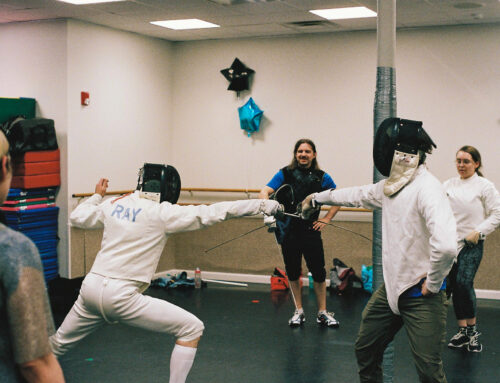
You can watch a video of this idea in action from this past week’s rapier class. Notice how the folks in the student role seek to keep control over their partner’s weapon until they have a good opportunity to strike.
Happy fencing!
Best,
—Justin
Head Coach
Boston Academie d’Armes
(he/him)