Happy New Year!
Our classical fencing crew will be kicking off 2026 with an exploration of Actions on the Blade. These are blade movements meant to deviate or deflect the opponent’s steel during the attack. Most often these are done against a blade in line, but not always.
In general, our system has nine actions on the blade:
- Blade seizure
- Changes of engagement
- Transports
- Envelopments
- Beats
- Expulsions
- Pressures
- Blade covers
- Disarmaments
These are used in compound attacks (2+ movements) and can be used to initiate attacks or to aid in riposting.
Just Beat It!
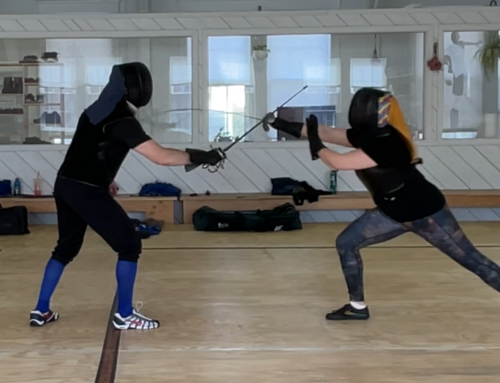
A classic action on the blade in fencing is the beat. The beat is a measured blow of violence (strong on medium or medium on weak) to knock the opponent’s blade out of it’s position in line and can be done with the true or false edge. Basically, a small mini-cut into the opponent’s weapon to knock it away and open a target.
It’s an action that grew in popularity during the classical fencing period where weapons were lighter and faster. Earlier rapier masters, such as Fabris, warn against the use of the beat since it can easily be defeated with a cavazione (disengagement). With that said, mid-17th century rapier masters like Pascha (1661) make well use of the beat. Capoferro (1610) even uses a false-edge beat as a parry in his treatise.
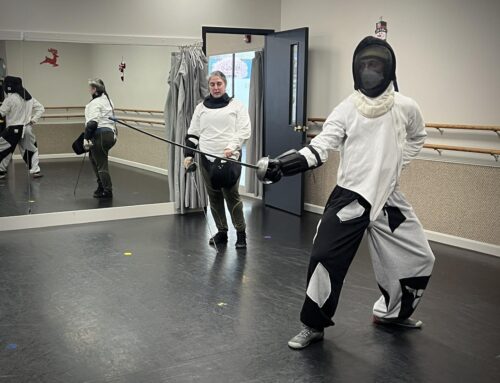
So for January, our Sunday classical fencing crew will look at using various actions on the blades with foil, dueling sword, and saber to create offensive opportunities — direct attacks and feints — as well as aiding ripostes. Though rapier class will explore rapier & dagger (or other secondaries) in January, anything folks learn in this month’s classical class can be easily carried over to rapier. So have fun!
The first video shows a simple beat of 1st in Italian saber, plus various ways of completing the attack. Demoed my Maestro Sullins and Maestro Dobbs of SSU FMCP. The second video shows how the beat can be used to gain intel on an opponent.
Happy Swording!
—Justin
Head Coach | Instructor at Arms
Boston Academie d’Armes
(he/him)