This past summer I took the online Fencing Pedagogy & History class, as part of the Sonoma State University Fencing Master Certificate Program (SSU FMCP). The class itself deals with traditional Italian fencing pedagogy and Franco-Italian fencing history. I took it as part of the requirement to test for Provost of Arms (which I’m aiming for, if all goes well, summer 2026).
Part of the online class requirements is to write a paper on a fencing topic. I bounced around a few ideas, but settled on yielding glides as they’re an action I enjoy but is one that doesn’t really exist in modern or classical fencing. So I wanted to explore it’s use in fencing from the 17th centuries onward. I also wanted to see how the action could fit in modern historical fencing and classical fencing lessons.

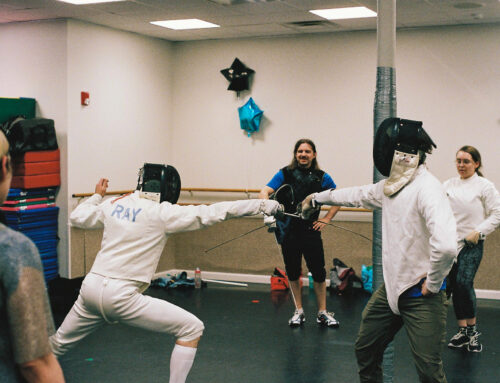
Yielding glide of 2nd as a renewed attack, from Bruchius

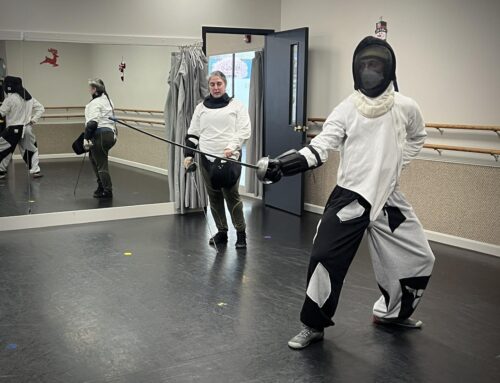
Yielding glide of 4th with a girata as a counterattack, from Fabris
What the Heck is a Yielding Glide?
Maestro David and Dori Coblentz, in their book Fundamentals of Italian Rapier, define the yielding glide as an action that is “used against a strong engagement from your opponent. Instead of responding to the pressure on your weapon with a disengagement, you can yield to the engagement and angle around the weapon to hit while maintaining contact.”
In short, instead of opposing the force an opponent is putting against your blade or disengaging around it, you yield to it. This works off a similar principle as yielding or ceding parries found in classical fencing books, a defensive feature in modern Italian fencing traditions which yields to the pressure of a glide instead of trying to oppose it with counterforce.
Yielding glides are performed by turning the hand so the false edge of the blade faces the opponent’s weapon and with one’s hand a little outside the silhouette of one’s body to angle around the opposing steel.
It’s a great action to use against opponents who are much stronger than you and use that strength to bully your blade by overcommitting on engagements and parries. In the paper, I look at several fencing masters who use the action as:
-
A simple attack
-
A counterattack
-
With feints
-
As renewed attacks
This paper, entitled Yielding to the Pressure: A Look at the Historical Use of the Yielding Glide and its Practical Application in Modern Historical and Classical Fencing, is the end result.
Figure I would share it with folks who are interested in historical fencing and sword research.
Happy Swording and Happy Reading!
—Justin Aucoin
Head Coach | Instructor at Arms
Boston Academie d’Armes
(he/him)