March is Women’s History Month and March 8th is International Women’s Day, so this month I wanted to focus on women in fencing and swordplay, and to highlight some interesting historical women fencing figures, manuals, and dates.
Where there’s been swordplay, there’s been women.
The earliest depiction of a woman fencing in a European swordplay manual that we currently have is Walpurgis. She appears in four illustrations of Royal Armouries MS I.33, often just called I.33 or FECHT 1 but also fondly known as Walpurgis Fechtbuch.
In this manual, Walpurgis is showing wielding a sword and buckler against a priest. Little is known about her or why she suddenly appears in the manual’s drawings. You can read more about her and the manual in this blog post.

Women continue to appear in various other historical martial art treatise, such as in Talhoffer’s very bizarre looking judicial duel portraits where the man is in a pit armed with a club and the woman outside the put armed with rock and sling. There’s also some debate if some of the figures in Bondì di Mazo’s manual (1696) are women. And there’s imagery of women wielding swords and shields that appear in artwork of many medieval books, such as the Roman de la Rose (MS. Douce 195) (1475) (bottom right image below).
Then there’s more historical figures, such as Joan of Arc, who led the French recapture much of the country back from England during the Hundred Years War.
There’s also the lesser known Julie d’Aubigny, aka the Mademoiselle Maupin or La Maupin (bottom left image). She was a French opera singer and a prolific fencer. In one instance, she dressed as a man at a court ball and kissed a woman whose attentions three noblemen were seeking. The three men challenged La Maupin to a fight, and she defeated all three in fencing duels. She then had to flee Paris since dueling was outlawed.
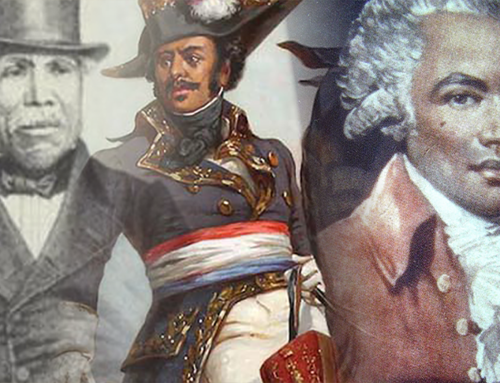
Then there’s the remarkable Chevalier d’Éon (bottom center image), a French spy, soldier and diplomat who lived the first half of their life as a man (Charles) and the second half as a woman (Charlotte). They even fought a fencing exhibition against the renowned Chevalier de St. George (who is an interesting historical figure in their own right).
And that’s just a smidge of European history, where my knowledge is centered and ignores the rich and vast history and culture of other parts of the world. No doubt many interesting figures and tales lay there, too.


This isn’t to say that swordplay wasn’t considered to be, historically, mostly a masculine affair or that women who picked up a sword or foil didn’t run into issues.
 For example, sport fencing has been part of the Summer Olympics since 1896, women weren’t allowed to fence in the Games until 1924. And then, they were regulated to just foil for decades. Women’s epee was introduced into the Games in 1996 and women’s saber just in 2000. Most of us were alive well before women were allowed to compete in epee and saber in the Olympics.
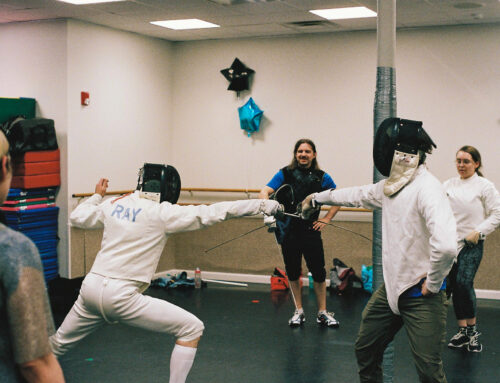
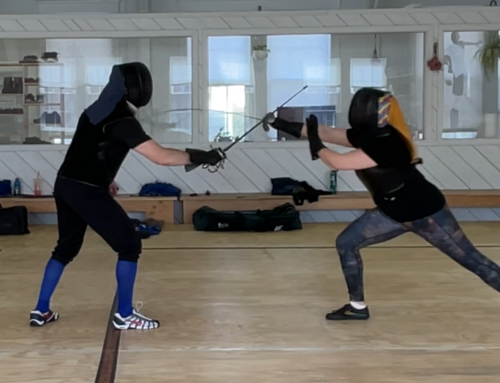
That brings us to modern day historical fencing with the SCA and HEMA. Two sides of the same coin of sword-nerdery and fun. The Academie is fortunate in its young life to have to so many amazing women pick up the sword and study with us, support one another, and share their passion and talents for historical swordplay.
The Academie is lucky to have such a fantastic band of fencers and swashbucklers show up every week.
Best,
—Justin
Head Coach
Boston Academie d’Armes
(he/him)