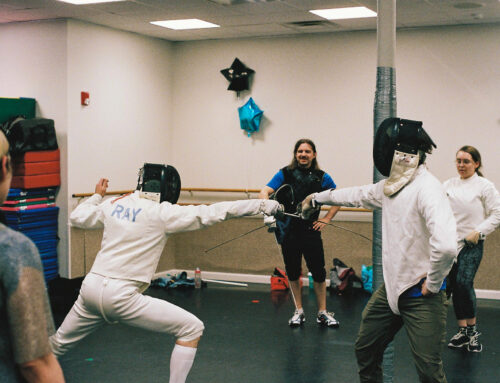
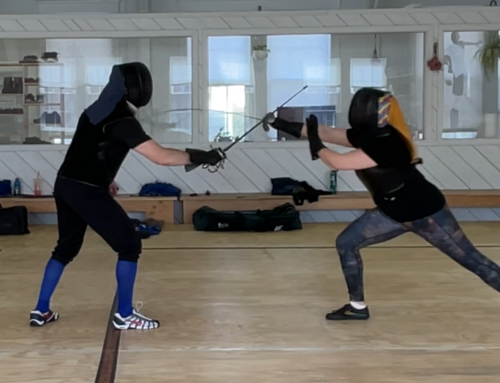
This month I wanted to take a step back from the technical side of fencing to look at how you get the most of your fencing practice — either with the Academie, an SCA practice or any other HEMA school.
Show Up Early. Doors open before all of our classes (and private sessions) about 15 minutes before official start time. Showing up early is great if you have anxiety and do better with some pre-class social time to settle in and/or you know you need a longer warmup than class can typically offer.
Have Goals in Mind. In group classes (or even private sessions), it’s good to have a training goal in mind. This is especially true when we’re going through our Core Actions that we do every week before the lesson of the day. Some examples are focusing on a powerful, explosive lunge and quick recovery, or fine-tuning your blade mechanics on the finding and/or parry.
If the practice is more sparring-focused, it’s good to go into the practice or each match with a specific goal. It doesn’t always (or should be) win, win win. Sparring goals can be as simple as focusing on a particular technique (such as parry-ripostes) or not getting hit for as long as possible against someone much more experienced than you.
Take Notes. Consider getting a notebook and write about your fencing. Log how you feel and performed at practices, classes, and tournaments. Write down things you learned and want to remember, insightful tidbits, things you were working on, and any useful feedback you got from coaches and sparring partners.
Advocate for Yourself. I truly believe that students are in charge of their own fencing education. Coaches and instructors are there to guide fencers, build technical and tactical tools, and aid in bringing out the best in each athlete. And while trying to balance 10 students needs in group class can get tricky, fencers should still feel comfortable advocating for their fencing education needs.
If you feel like class or a drill is too difficult or too easy, talk to one of the instructors. There’s always ways of making things more or less challenging. You should leave class feeling like you were challenged, learned something, and generally positive about your training experience.
As always, happy to answer any questions you have.
Happy fencing!
Best,
—Justin
Head Coach
Boston Academie d’Armes
(he/him)