We just wrapped up a two-month long training block on defense and last month’s newsletter looked at various ways of parrying an attack and then riposting. This is also called a two-tempi (or dui-tempi) action because it takes two tempo to perform. The first tempo is the parry, and the second is the riposte.
Two-tempi actions are often described as “spending a tempi to gain a tempi” — i.e., spend a tempo to gain a greater advantage to exploit.
There are downsides to two-tempi actions, however. To start, they take longer than single-tempi actions — a beat & straight thrust takes longer than a standard straight thrust. They can also be exploited more readily — a feint can exploit the parry-riposte.
Because of this, many folks prefer single tempo actions. When put into a defensive lens (like we did last month), this means counterattacks. Counterattacks are offensive actions opposed to attacks. In other words: when your opponent attacks you, you attack them at the same time.
The upside of counterattacks is, if performed correctly, your opponent can’t run away from your strike. You’re literally hitting them in the middle of their own attack. If you were to parry-riposte, your opponent could potentially recover from their attack and counter-parry your riposte.
The downside of counterattacks is that they require precise timing and body movement. Counterattacks can often lead to double hits, so practice, precision, and discretion is key.
Counterattacks are good against opponent’s who are repetitious in their actions, so if you know your opponent is going to attack in a particular way and a particular line, you can exploit it with a counterattack.
What are Some Common Counterattack Types?
There are many counterattacks in our system, but here are the ones we focused on last month:
-
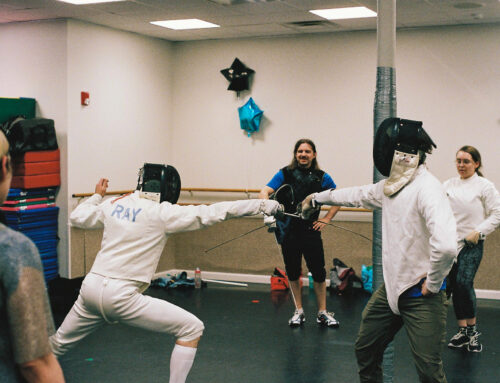
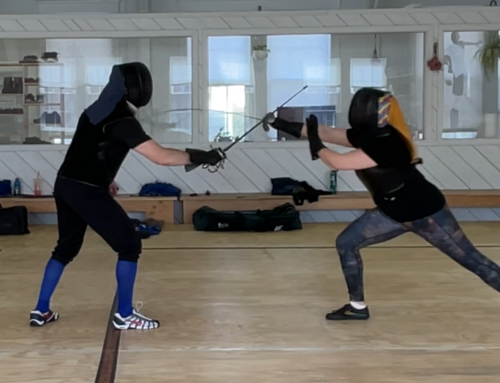
Arrest with Reassemblement. Used against attacks to the leg. See banner image for example.
-
Time-thrust. A thrust along the same line as the opponent’s attack, striking and shutting out the line at the same time.
-
Passata Sotto. Used against attacks to the high-outside line by voiding the body below the opponent’s attack.
-
Intagliata. Used against attacks to the high-outside line by stepping crossline, across the line of direction to one’s inside.
-
Girata & Inquarata. Used against attacks to the inside line by voiding the offside shoulder and stepping offline with either the front or back foot.
Which is best? There’s a time and place for everything. If you only parry-riposte, you’ll fall prey to feints and counter-parries but if you only counterattack, you’ll earn yourself a lot of doublehits. Practicing both and having a good understanding of when to use various actions will go a long way.
Happy swording!
—Justin
Head Coach | Instructor at Arms
Boston Academie d’Armes
(he/him)