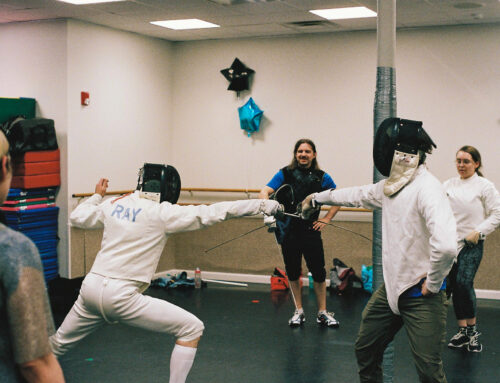
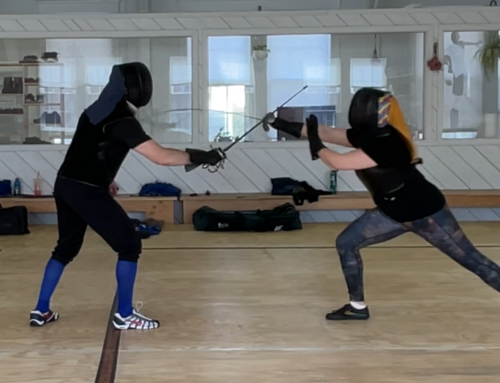
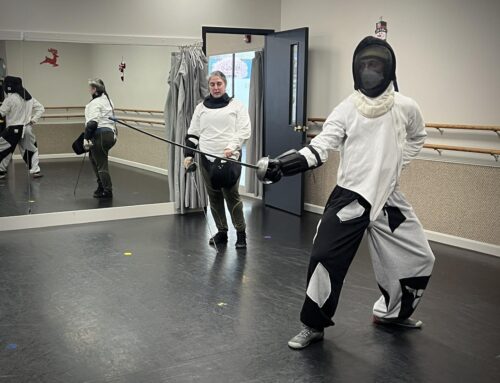
Last month was the SCA East Kingdom’s Rapier Championship Tournament. We had several fencers compete and do well, including the overall winner, two fencers in the Sweet 16, and career-best performance in pools for another three. Overall, it was a great day for the Academie.
But the wins and losses isn’t what I want to really talk about this month.
After the event, I ran a small workshop with the local fencers to go over their tournament performance and put it into context (a post-mortem, if you will), as well as build some goals. The EK Rapier Champs tournament is particular rough. You can go 8-2 in pool play and not make it out into the bracket. It’s brutal.
So it’s pretty easy to just look at not making out of pools as a failure. And while “one may have failed in their goal to get out of pool play, it’s important to look at the performance as a whole and in context.
Here’s the process we took.

Step 1. Jot down the Basics
So we did just that in our workshop. First, folks wrote down some basic event info basics:
- Event Name
- Event Date
- Record (if known)
- Who else was in your pool (were you in a pool full of beginners, a mix, or the best of the best?)
Step 2. Real World Stuff Matters
After that, we looked at real-life, non-tourney specific things that may have contributed to one’s performance (both good and bad)
- What did you have to eat and drink (night before & morning of)?
- Anything noteworthy happen in real life leading up to the tourney? (didn’t sleep well, got laid off, drove 8hrs, kids were sick all week, etc.)
- How did you physically feel morning of the tournament?
- What was your mental state before the tournament?

Step 3. What We Did Well & Didn’t Do Well
Then we folks wrote down things they thought they did well or not-so-well, and categorized them. I specifically want folks to write more good things than bad:
- 3-5 things you did well or are proud of
- Categorize: Technical, Tactical, Other
- 2-3 things you didn’t do well
-
Categorize: Technical, Tactical, Other
-
Step 4. Analyzing Our Plus & Minuses
We then took that list and figured out how we could continue leveraging the good things and patch up the less-good things:
-
Choose 2-3 things you Did Well. How can you leverage that success going forward?
- Choose 1 or 2 things from the Didn’t Do Well list. What can you do to improve those areas?

Step 5. Be SMART
Lastly, we wrote up some SMART goals:
-
Pick 1-3 goals for the next 6-12 months.
- What support will you need to improve or achieve these goals? Who would be a good contact or support buddy to help?
The main objective of this workshop was to let folks analyze their performance in a healthy way, take into account any IRL issues that may have hindered (or helped) performance, and create a roadmap for moving forward from the event.
These questions can be used after any event, though one doesn’t need to write up new goals after each event. Doing goals 2x a year is well enough, but you could swap out that section for “Insights Learned” where you jot down things you learned about your fencing or others and/or see how you did compared to goals you’ve previously set up.
Give it a try your next tournament and customize it as you need. 🙂
Happy Swording!
—Justin
Head Coach | Instructor at Arms
Boston Academie d’Armes
(he/him)