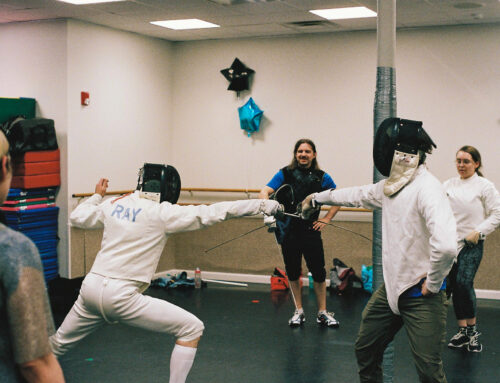
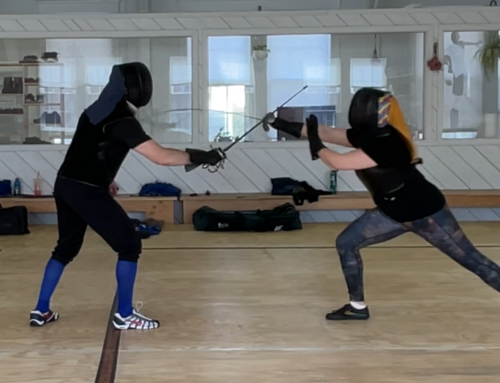
The last few months in the Academie’s classical fencing class, we’ve been putting an extra focus on various parrying and riposte options. This is, after, the Art of Defense and step one of any duel is to not get hit.
Now that April has rolled in, we’re starting a defense-focused block in our rapier class, too. So in this letter, we’re going to do a super quick overview of defense in the Italian fencing system.
First off, there are two general categories of defense:
- Defense of steel. Redirecting attacks away from our body, such as parries.
- Defense of measure. Using footwork to move out of the way of an attack, such as a retreat.
5 Types of Parries
In general, defense of steel is better as you can switch to offensive immediately. So let’s focus on that. In our system, we have five types of parries:
- Simple Parry. Parry that travels the shortest route to stop the attack (e.g. 3rd to 4th).
- Circular Parry. Parry that travels in a tight, complete circle around the oncoming steel, intercepting it and transferring it to the opposite line (e.g. 4th to 4th).
- Half Circular Parry. Parry that travel along a diagonal semicircular route from high to low (or vice versa) to stop the attack (e.g. 4th to 2nd).
- Yielding/Ceding Parry. Parries that, instead of resisting an attack, yield to it and redirects the attack further in the direction it was intending (e.g. 3rd to 1st).
- Offhand/Secondary Weapon Parry. Parries used with the open offhand or a secondary weapon instead of the sword.
All of these are great parries to learn and master. Some parries are situational, some can be exchanged for one another.
In the Italian system, every offensive action has a defensive component (such as closing the line when attacking) and every defensive action has an offensive component. When it comes to parrying, the offensive component is the riposte. It’s important to switch from the parry to the riposte immediately so our opponent doesn’t have a chance to fire off another attack.
Depending on the rule set, we can riposte with a thrust or a cut, and they can be performed in two main fashions:
- Simple (e.g. direct via glide or indirect via disengagement)
- Compound (e.g. feint and disengagement)
Below is a video I shot a few years ago that shows a few simple, thrust-centric riposte options for rapier. It’s not an exhaustive list, but it will give you a few options and tactical reasons for them.
Once we have all of these ideas under our hat, we can create some pretty interesting and complex actions. Here are few ideas, going from very simple to more complex:
- From the student’s finding of fourth, simple parry of third and riposte by glide
- From the student’s finding of fourth, simple parry of third and riposte by disengagement
- From the student’s finding of fourth, false-edge beat parry of third and riposte cut to cheek
- From the student’s finding of fourth, parry third, riposte by feint direct and disengagement
- From the student’s finding of fourth, parry of third, riposte feint by disengagement and circular cut to the cheek
When it comes to winning fights, simpler is often better. But for training and mastering the weapon, getting more complex can be a really fun challenge.
Happy training!
Best,
—Justin
Head Coach
Boston Academie d’Armes
(he/him)