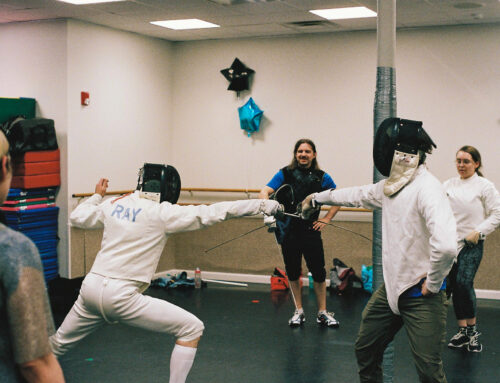
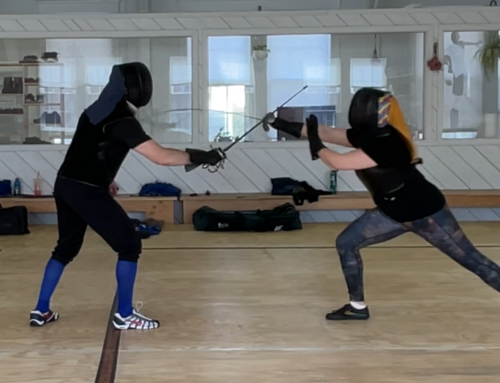
One of the biggest challenges of mixed-level group classes is just that — it’s mixed level. What a new fencer needs isn’t the same as someone who’s been fencing for a few months or something who’s been fencing for more than a decade.
Three Ways to Increase a Drill’s Challenge Rating
Drills need to be tailored to the student in question, but we usually default to simpler versions to help our new folks feel more comfortable. However, there are a few ways you can make any simple drill more challenging. I like to call this “adding spice” to the drill.
- Add mobility. Mobility is adding footwork (either teacher-led or student-led) to a drill. The student is either trying to keep distance with their partner (teacher-led) or are looking to manipulate distance (student-led) to achieve the given action.
- Add an afterblow. An afterblow is an attack that happens after the student has successfully landed their technique against the coach. (See vid below)
- Add options. You can also add options, meaning that the student needs to respond to two+ cues/stimuli by choosing the correct counter.
Let’s look at how these work in a simple attack by disengagement drill. A simple version we do is as the coach tries to engage (or counter-engage) the student’s blade, the student attacks by disengagement (striking the opposite line).
We can make this more challenging and realistic by adding mobility. In this case, the student is trying to keep distance with the coach. When the coach ties to engage the student’s blade, the student performs a disengagement in-time.
We can also add an afterblow. After the student lands their disengagement and recovers back, the coach can (at random) throw an afterblow. The student should parry and riposte, landing a second shot.
Thirdly, we can add options. So not only can the student attack by disengagement against the coach’s engagement, they could also parry-riposte if the coach attacks instead.
Lastly, you can also mix and match those “spices” for more interesting and challenging drills.
For example: You can add mobility and an afterblow or mobility and extra options. You can even add all three! Now the student is keeping distance, can attack by disengagement or parry-riposte, and also have to worry about the afterblow.
Our coaching staff does its best to balance the varying needs of the class. The good new is you’re also in charge of your own fencing education! If you’d like a drill to be more difficult, talk to your training partner to see what they can do so you’re feeling good and challenged. Our coaching staff is always happy to go over ways of making simple drills more challenging so you’re growing as a fencer.
Happy swording!
—Justin
Head Coach | Instructor at Arms
Boston Academie d’Armes
(he/him)