For the rest of the year, both our rapier fencers and our classical fencers will be taking a deeper dive into the art of deception in historical fencing. There’s a myriad of ways of exploring deception in swordplay. A handful of ideas:
- Feints (a popular classic)
- Invitations
- Yielding Glides
- Second Intentions
- Actions of Concealment
- Probing Actions
- Voids & Body Evasions
- Sneaky Footwork
One that often gets overlooked in historical fencing is footwork. Using footwork to create tempo or distance traps is a great way to create opportunities to strike your opponent.
One way is to use “sneaky footwork”* — basically create a footwork pattern and then break it when your opponent also falls into it.
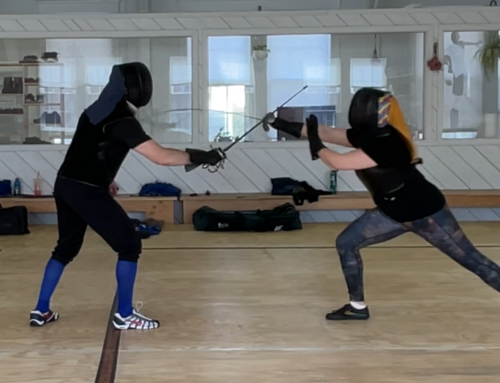
A simple example is to take two retreats and then an advance. You can use this pattern to get your opponent to advance with you twice and then retreat (the mirror of what you’re doing). After you get them into this pattern you can break it by performing a retreat and then a half-retreat. As the opponent takes their second step on your half-retreat you lunge forward, attacking an open target.
Another examples is in the inverse — two advances and then one retreat. Your opponent, ideally, will retreat twice and then advance once. They may eventually realize you stepping forward is a good opportunity to try to strike you, so when they attempt to, you can quickly retreat with a counter-thrust to the opponent’s head/torso or body, or perform some sort of body evasion (such as a passata sotto or giratta) to void their attack.
Another fun sneaky footwork is the gaining or gather step. This is when you bring your rear foot forward to meet the heal of your lead foot, stealing measure. The wider your original stance the more measure you can steal. You can mask this step with some sort of blade action to keep your opponent’s eyes busy.
Those are just a few ideas of how one can use footwork to create opportunities and to deceive one’s opponent. It’s certainly just scratching the surface.
Happy Swording!
—Justin
Head Coach | Instructor at Arms
Boston Academie d’Armes
(he/him)
*Sneaky Footwork is a term I first heard used by Maestra Dori Coblentz. Both of the patterns talked about in this note I first learned from her.
BONUS:
Great video on distance traps from OSM Fencing