At the Academie, we specialize in the dueling arts with the single-handed sword. Often this means fencing just single sword (be it rapier, smallsword, foil, or saber) or a sword with a secondary (such as cloak, dagger, etc.).
Then there’s the open offhand, a bit of a controversial element of historical fencing. In HEMA/SCA (especially the SCA), offhand work is perhaps a bit overused compared to what was advised in history. It’s an artifact of a few things, including that we fence with gloves and don’t use sharps.
Touching a sharp blade with just your bare hand is, not surprisingly, kinda dangerous. You can do it safely, but the hand is very vulnerable to being cut or stabbed by a sharp weapon. So we tend to de-emphasize the offhand use a bit for that reason at the Academie.
Of course, what we’re doing is a sport version so things like offhand work is a lot, lot safer and therefore more useful.
At the Academie, we primarily look at two main use cases for open-off hand use:
- As passive backup when attacking or defending, in a position called “closed guards.”
- More active in parrying opponent’s attacks or transferring the opponent’s blade from our blade to the offhand.
What are Closed Guards?
Closed guards are positions we take when attacking that close out both the high line and low line at the same time. The general rule is if the sword is closing the high line, the offhand covers the low line; if the sword is closing the low line, the hand is covering the high line.
The closed guard is meant to protect against late disengagements or counter-thrusts from the opponent. It’s passive backup.
Below are a couple of of example of closed guards from Alfieri (left) and Fabris (right).


The good news is the closed guards you learn with the open offhand can be easily transferrable to secondaries like dagger, buckler, and cloak.
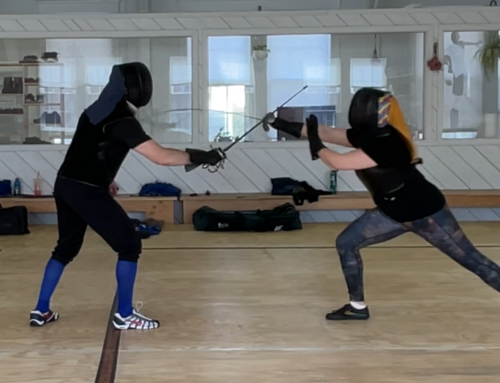
We can also be more active with our offhand parry work. The benefit of this is that, like parrying with any secondary weapon, it leaves our sword free to strike in the same tempo at any angle we need. The offhand is easily deceived however and can be stabbed/cut, so discretion is needed when parrying with the open offhand.
Other offhand use includes the controversial blade grabbing, as well as seizing the opponent’s hilt and disarms.
Happy Swording!
—Justin
Head Coach | Instructor at Arms
Boston Academie d’Armes
(he/him)